
edesignsit
edesignsit is an interdisciplinary artist and community arts professional living and working in the Detroit area. Her current art practice focuses on representing concepts of human behavior and emotions through process-based art, while investigating a multitude of materials.
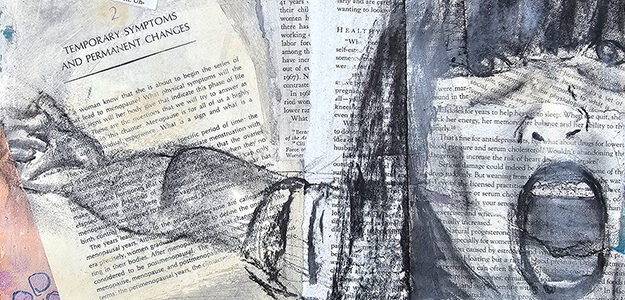
With the process needing to be a part of my concept, the base layer for all my paintings are book
pages. Paper is one of the most common, useful materials in the world. Paper making is like a ritual
or a spiritual act, where the material itself becomes a conduit for deeper meaning. Paper isn’t just
a physical medium, but a way for the human spirit to express or record its thoughts, emotions, and
experiences. It transmits something personal to the world. It echoes how words or art can resonate
beyond their physical form, carrying with them the energy or essence of the creator. Paper represents
the receptacle element in the art process. The new blank paper can evoke freedom of expression,
while in others it will provoke the fear of the blank paper, “Horror Vacui” (In visual art, horror vacui, or
kenophobia, is a phenomenon in which the entire surface of a space or an artwork is filled with detail
and content, leaving as little perceived emptiness as possible.)
The act of ripping out the page of a book and adhering it to the canvas is a way for me to rewrite
the story and choose my own narrative, controlling what the viewer will see. Tearing a page is like
breaking a taboo, expounding energy and expressing anger. Feelings like anxiety and discomfort can
arise, especially when ripping pages from a bound book. There can also be feelings of playfulness, like
you’re doing something forbidden. This process reflects tactile, kinesthetic, auditory and visual sense,
setting me up to start at a somewhat hasty pace, grabbing books, ripping pages out and arranging
them on the canvas. I frantically scan for meaningful text. I rip, shred, tear… forming, seeking, finding.
Am I looking for answers? Am I looking for things to make me angry? Am I looking to blame some
outdated text? I wet the pages and begin adhering them to the canvas with the acrylic medium.
Wetting the paper allows it to be laid down smoother, forming tight to the canvas. I’m forced to calm
down during this process and make quick deliberate choices as the acrylic medium will dry fast. In
this stage, I carefully smooth the wet paper so it doesn’t rip, paying close attention to text and what it
means to me, feeling the emotions as I do, and giving me ideas of what I might want to show through
the paint layers. I want the papers to go in exact places but they won’t behave, so I have to be ok with
the lack of control and accept that what’s happening with them is all right.